Air Conditioner Rebate Victoria: VEU Discounts and the Rental Cooling Rule
How much is the Victorian air conditioner rebate, and does my landlord have to provide cooling?
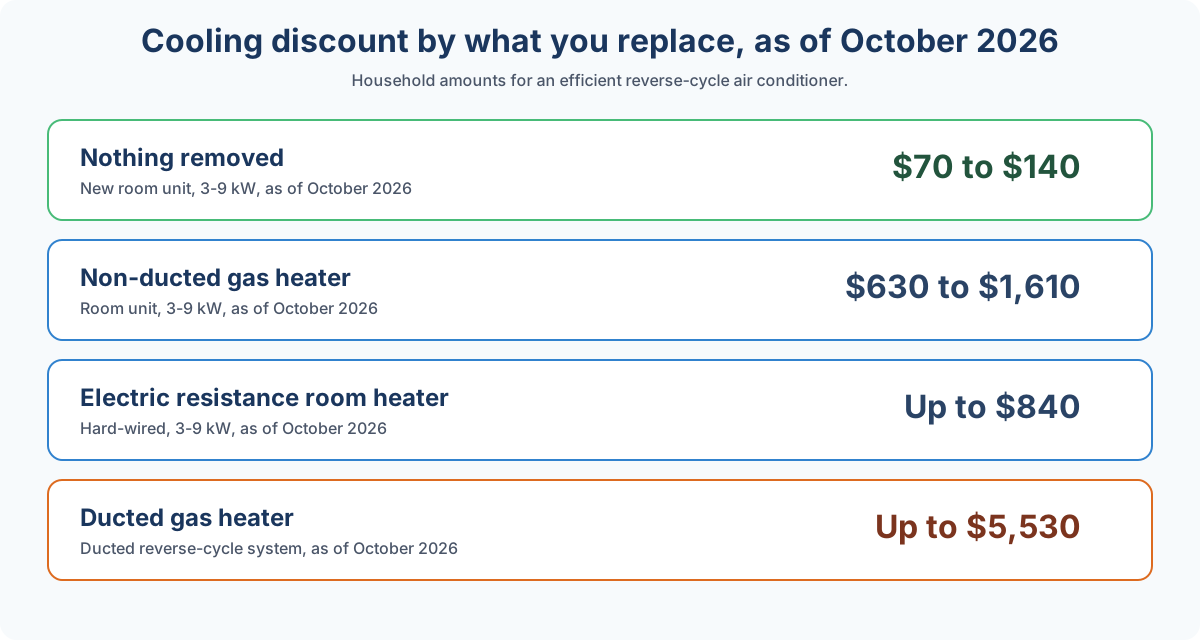
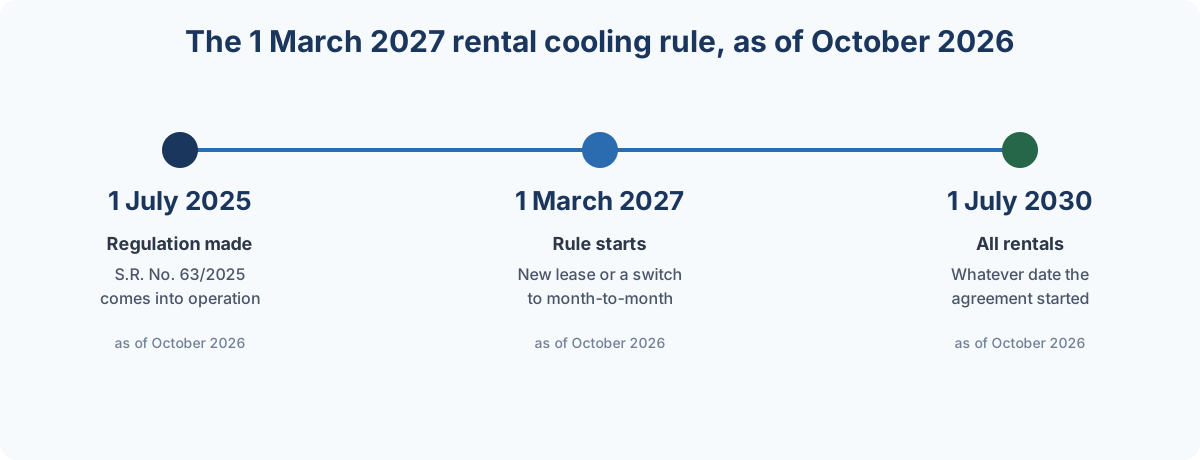
As of October 2026, it depends on what you're replacing: a VEU discount on an efficient reverse-cycle unit is $70 to $140 with nothing removed, and up to $5,530 when a ducted gas heater goes. From 1 March 2027, landlords must provide efficient fixed cooling at a new or month-to-month lease, and in all rentals from 1 July 2030.
As of October 2026, the biggest VEU discounts come from removing a gas or electric resistance heater, while a room unit with nothing removed gets $70 to $140. You still pay at least $200, and more for ducted or multi-split systems. The rental cooling rule is law under S.R. No. 63/2025 and starts on 1 March 2027.
In this guide
- Discount by what you replace
- Who and what is eligible
- What you must still pay
- Must my landlord provide cooling?
- What counts as efficient cooling
- If the rental already has a cooler
- Exemptions
- Renters installing aircon
- One unit for heating and cooling
- What a landlord gets off
- Official sources
- Related SettleAU guides
Check your own situation. This guide is general information based on official pages checked on 31 October 2026.
VEU discounts are indicative and change often. Your accredited provider confirms your discount in the quote (energy.vic.gov.au).
How much is the discount for what you're replacing?
The discount depends on the system you're replacing (energy.vic.gov.au). These are the household amounts, as of October 2026.
Room (non-ducted) reverse-cycle air conditioner
| Replacing | Size | Discount (as of October 2026) |
|---|---|---|
| Hard-wired electric resistance room heater | 3 to 9 kW | Up to $840 |
| Non-ducted (room) gas heater | 3 to 9 kW | $630 to $1,610 |
| Ducted gas heater, replaced with 4 splits | 1 × 8 kW + 3 × 3 kW | Up to $2,520 |
| Ducted gas heater, replaced with a multi-split | 1 × 10 kW outdoor unit | Up to $2,940 |
| Non-ducted reverse-cycle unit | 3 to 9 kW | $210 |
| Nothing (new install, no old product) | 3 to 9 kW | $70 to $140 |
Source: (energy.vic.gov.au), last updated 29 October 2026.
A gas wall heater is a non-ducted gas space heater, which VEU describes as "such as a single room heater". Replacing one with an efficient reverse-cycle unit gets $630 to $1,610, as of October 2026 (energy.vic.gov.au).
Installing a new gas heater gets no VEU discount. Gas space heating was removed from the program on 30 June 2023 (ESC, energy.vic.gov.au).
Ducted reverse-cycle system
| Replacing | Size | Discount (as of October 2026) |
|---|---|---|
| Central electric resistance ducted heater | 10 to 22.4 kW | Up to $5,460 |
| Ducted gas heater | 10 / 16 / 22.4 kW | Up to $2,520 / $4,200 / $5,530 |
| Ducted reverse-cycle system | 10 / 16 / 22.4 kW | Up to $490 / $770 / $910 |
| Nothing (new install) | 10 to 22.4 kW | Up to $410 |
Source: (energy.vic.gov.au), last updated 29 October 2026.
As of October 2026, replacing a non-ducted gas space heater can save up to $460 a year. Replacing a ducted gas heater with a ducted reverse-cycle system can save up to $1,140 a year (energy.vic.gov.au, energy.vic.gov.au).
Running an air conditioner in the free midday window is a separate bill question. See free electricity from 11am to 2pm.
See every other VEU discount on our VEU discounts page.
Who is eligible, and which systems count?
"All Victorian households and businesses are eligible for a heating and cooling discount." Private rental properties are eligible too (energy.vic.gov.au).
- It must be an approved high-efficiency reverse-cycle air conditioner that heats and cools (energy.vic.gov.au).
- Homes need a warranty of at least 5 years (energy.vic.gov.au).
- If it replaces an old system, the property must be more than 2 years old (energy.vic.gov.au).
- Only an accredited provider, or an installer working with one, can apply the discount (energy.vic.gov.au, energy.vic.gov.au).
Book before you buy. Claims after the job are only possible in limited circumstances (energy.vic.gov.au).
How do I check a provider is accredited?
Only accredited providers can apply a VEU discount. To check one, use the Essential Services Commission's VEU Public Registry: open the "Accredited Persons" report and search the business name (ESC). Each VEU discount page on energy.vic.gov.au also lists accredited providers (energy.vic.gov.au).
As of 31 October 2026, the ESC says registry reports are temporarily unavailable. Until they're back, use the provider lists on the energy.vic.gov.au discount pages (ESC, energy.vic.gov.au).
Since 1 May 2024, VEU businesses can't cold-call you, and since 1 August 2024 they can't doorknock, unless you agreed first (energy.vic.gov.au, ESC). They must also:
- tell you which business they work for
- not say they work for the Victorian Government
- not say an upgrade is mandatory
Taking part is voluntary (energy.vic.gov.au, ESC).
To report a cold call, doorknock or VEU problem, contact the ESC on (03) 9032 1310 or veu@esc.vic.gov.au. For false or misleading claims, contact Consumer Affairs Victoria on 131 450 (energy.vic.gov.au).
How much must I still pay after the discount?
Since 30 September 2026, you must pay a minimum amount towards each system, even after the VEU discount. This comes from VEU Specifications version 25.0 (ESC).
| System | You pay at least, incl. GST (as of October 2026) |
|---|---|
| Ducted air conditioner | $3,000 |
| Multi-split, 10 kW or more | $3,000 |
| Multi-split, under 10 kW | $1,000 |
| Single split, 10 kW or more | $1,000 |
| Single split, under 10 kW | $200 |
Before 30 September 2026, ducted systems and multi-splits of 10 kW or more had a $1,000 minimum. The other minimums didn't change (ESC).
Be wary of "free air conditioning" offers. You must pay the minimum amount before the discount is claimed, and it can't be refunded to you in any form (ESC). Your provider confirms the discount and what you pay in the quote (energy.vic.gov.au, ESC).
Does my landlord have to provide air conditioning in Victoria?
Yes, in stages. The cooling standard is law: S.R. No. 63/2025 added it to the Residential Tenancies Regulations 2021, from 1 July 2025 (S.R. No. 63/2025, Regulations).
| From | Who it applies to | What's needed |
|---|---|---|
| 1 March 2027 | Agreements entered into or created on or after 1 March 2027, including a new lease or a switch to month-to-month (CAV, CAV, S.R. No. 63/2025) | An energy-efficient fixed cooler in good working order, in the main living area or with an outlet there |
| 1 July 2030 | All rental properties, whenever the agreement started, unless an exemption applies (CAV, CAV, S.R. No. 63/2025) | The same cooling standard |
For a rental with no fixed cooler, the trigger is the lease date, not a breakdown. Heating works differently: the new rule only applies when the old heater fails (CAV, CAV, CAV).
What counts as energy-efficient cooling?
- A non-ducted electric air conditioner or heat pump with a GEMS 3-star or higher cooling rating for the property's climate area (CAV, S.R. No. 63/2025).
- A ducted electric air conditioner or heat pump with a Total Cooling Seasonal Performance Factor of 3.8 or higher (CAV, S.R. No. 63/2025).
The regulation defines a fixed cooler as one "not designed or manufactured to be portable", so a portable unit doesn't meet it (CAV, CAV, S.R. No. 63/2025, authorised PDF).
What if the rental already has a cooler?
- A fixed cooler in good working order installed before 1 March 2027 is an exemption (CAV).
- Room evaporative coolers, reverse-cycle units and window air conditioners must be upgraded to the standard when they fail and can't be repaired (CAV).
- A ducted evaporative cooler can be replaced with another ducted evaporative cooler (CAV).
Are there exemptions?
Yes. Examples include (CAV, CAV, S.R. No. 63/2025):
- centralised building systems
- heritage or owners corporation rules
- installation cost significantly higher than average
- needing network augmentation
- a fixed cooler in good working order installed before 1 March 2027
If the efficient unit is unreasonable to install, a fixed cooler in good working order is still required (CAV, S.R. No. 63/2025).
I rent. Can I install an air conditioner myself?
Not without your landlord's permission. Installing an air conditioner is not on CAV's list of changes renters can make without asking, and VEU says cooling needs landlord approval (CAV, energy.vic.gov.au).
Repairs and what a landlord must provide are covered in your first Australian tenancy.
But your landlord can't refuse without a good reason if the change is needed so you're not too hot or cold, or to reduce energy bills (CAV).
- Who does the work: your landlord can ask for a suitably qualified person (CAV).
- Who pays: even if your landlord agrees, they don't have to pay (CAV).
- If they refuse: ask why. If it seems unreasonable, you can apply to VCAT (CAV).
- Broken cooling: if a cooling appliance your landlord provided stops working, that's an urgent repair (CAV).
Meeting the cooling standard is your landlord's job (CAV). Read more on the rental upgrades hub.
Can one air conditioner cover heating and cooling?
Yes. A reverse-cycle air conditioner can meet both the heating and the cooling standard (CAV). See the heating guide for the heating rule.
What discount will a landlord get to meet the cooling rule?
It depends on what's already there. A rental with no cooler that adds a room reverse-cycle unit gets only the "nothing replaced" discount: $70 to $140, as of October 2026 (energy.vic.gov.au).
The large discounts need a gas or electric resistance heater to be removed (energy.vic.gov.au). For rental providers, energy.vic.gov.au lists up to $1,610 for a gas space heater and up to $5,530 for a ducted gas heater, as of October 2026 (energy.vic.gov.au).
The minimum contribution still applies, for example $200 for a single split under 10 kW, as of October 2026 (ESC). Landlords can use VEU at any time, including when a reverse-cycle air conditioner fails (energy.vic.gov.au).
Check what your rental needsOfficial sources checked on 31 October 2026
- CAV: New minimum energy efficiency standards (last updated 21 October 2026)
- CAV: Cooling standard (last updated 5 June 2026)
- CAV: Heating standard (last updated 5 June 2026)
- CAV: Exemptions to the new standards (last updated 26 October 2026)
- CAV: Renters making changes to the property (last updated 13 October 2026)
- Residential Tenancies Amendment (Minimum Energy Efficiency Standards) Regulations 2025, S.R. No. 63/2025 (as made, 1 July 2025)
- S.R. No. 63/2025, authorised PDF (as made, 1 July 2025)
- energy.vic.gov.au: Energy efficiency for rental properties in Victoria (last updated 9 October 2026)
- energy.vic.gov.au: VEU heating and cooling discounts (last updated 29 October 2026)
- energy.vic.gov.au: VEU for renters, landlords and body corporate (last updated 28 August 2026)
- energy.vic.gov.au: About Victorian Energy Upgrades (last updated 13 October 2026)
- energy.vic.gov.au: VEU retrospective discounts (last updated 14 October 2026)
- energy.vic.gov.au: Victorian Energy Upgrades for homes (last updated 15 October 2026)
- Residential Tenancies Regulations 2021, in-force version 009 (version 009, in force from 30 June 2026)
- ESC: Changes to space heating and cooling incentives and consumer co-payments from 30 September 2026 (published 30 September 2026)
- ESC: Water heating, space heating and cooling, weather sealing and HERA updates (2023) (no update date shown)
- energy.vic.gov.au: VEU products (no update date shown)
- CAV: Repairs in rental properties (last updated 27 February 2026)
- ESC: Find an accredited provider (VEU Public Registry) (no update date shown; registry reports temporarily unavailable on 31 October 2026)
- ESC: Your consumer rights under the VEU program (no update date shown)
- energy.vic.gov.au: Telemarketing and door knocking under the VEU program (last updated 5 August 2024)
- energy.vic.gov.au: Your rights under VEU (last updated 5 August 2024)
- ESC: Water Heating and Space Heating Cooling Activity Guide v3.22 (PBL - Water Heating and Space Heating Cooling Activity Guide - V. 3.22 - 20261030.docx) (published 30 October 2026)
General information only: This guide is not legal or financial advice and is not from a government agency. Discounts and rules can change. Check the linked official pages and ask an accredited provider before you act.