Victorian Energy Upgrades Program (VEU) Discounts: A Guide for Renters and Landlords
What is the Victorian Energy Upgrades program, and can I (or my landlord) get a discount?
As of October 2026, it depends on the upgrade and who owns the home. All Victorian households can get Victorian Energy Upgrades (VEU) discounts, but renters need landlord permission for heating and cooling. An accredited provider takes the discount off your quote, and air conditioners, hot water systems and ceiling insulation have a minimum you must pay.
As of October 2026, VEU discounts come off your quote up front, and only accredited providers can give them. Air conditioners, hot water systems and ceiling insulation have a minimum you must pay, from $200. Book before you buy, because claims after the job are only allowed in limited cases.
In this guide
Check your own situation. This guide is general information based on official pages checked on 31 October 2026.
VEU discounts are indicative and change often. Your accredited provider confirms your discount in the quote (energy.vic.gov.au).
How does the VEU program work?
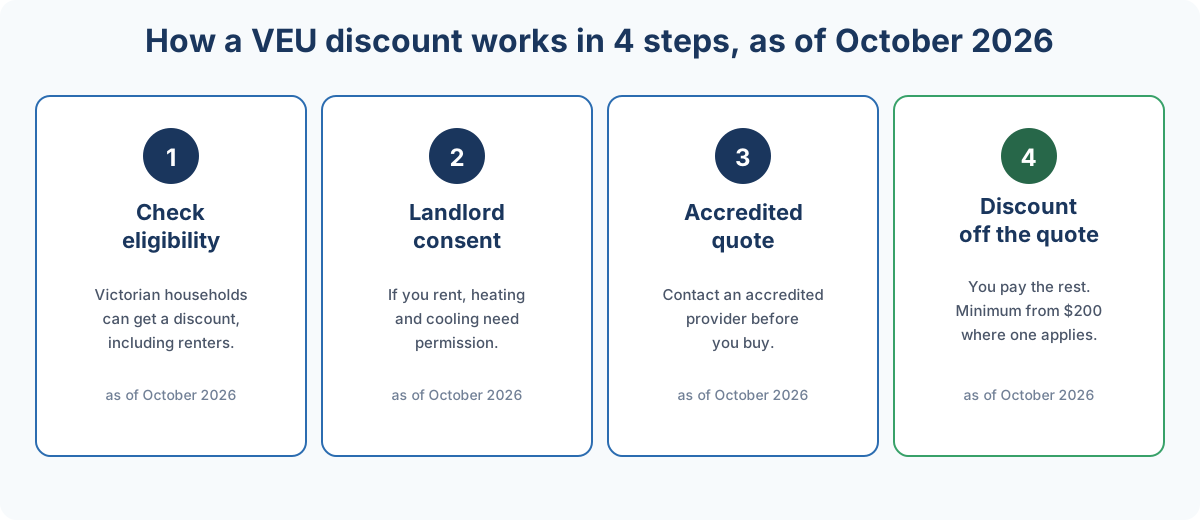
The discount is applied up front on your quote, so you only pay the rest (energy.vic.gov.au, energy.vic.gov.au).
Only accredited providers can apply it. You can use your own installer if they work with an accredited provider (energy.vic.gov.au, energy.vic.gov.au, energy.vic.gov.au).
Accredited providers create Victorian Energy Efficiency Certificates and sell them to energy retailers. One certificate equals one tonne of greenhouse gas avoided. That sale pays for your discount (energy.vic.gov.au).
Who can get a VEU discount?
- Households: "All Victorian households are eligible for discounts" (energy.vic.gov.au).
- Renters: renters in Victoria are eligible for upgrades under the program (energy.vic.gov.au).
- Landlords: private rental properties are eligible (energy.vic.gov.au, energy.vic.gov.au).
- Owners corporations: eligible as residential (Class 1 to 4) or commercial premises (energy.vic.gov.au).
I rent. Can I use VEU?
Yes. Renters can get many VEU discounts, but heating and cooling upgrades need landlord approval (energy.vic.gov.au). Check with your landlord before you make changes (energy.vic.gov.au).
If you are setting up electricity at a new address, use the move-in utilities checklist alongside these upgrade rules.
Your landlord can't refuse without a good reason if the change is needed so you're not too hot or cold, or to reduce energy and water bills (CAV).
- Good reasons to refuse include heritage protections, a significant change to the property, or changes to common areas (CAV).
- Who pays: even if your landlord agrees, they don't have to pay for the change (CAV).
- If they refuse: ask why. If it seems unreasonable, you can apply to VCAT (CAV).
- Shower heads: if the home isn't heritage-listed, you can fit a low-flow shower head without permission. Keep the original (CAV).
- Draughtproofing: it needs permission, but your landlord can't refuse without a good reason if there are no gas appliances. With gas appliances, a licensed gasfitter must do a gas safety check first (CAV).
Remember: the minimum heating and cooling standards are your landlord's job, not yours (CAV, CAV). See what your rental needs on the rental upgrades hub.
What does VEU give discounts on?
CAV says every upgrade under the new rental standards is eligible for a VEU discount (CAV). Here is each discount, as of October 2026.
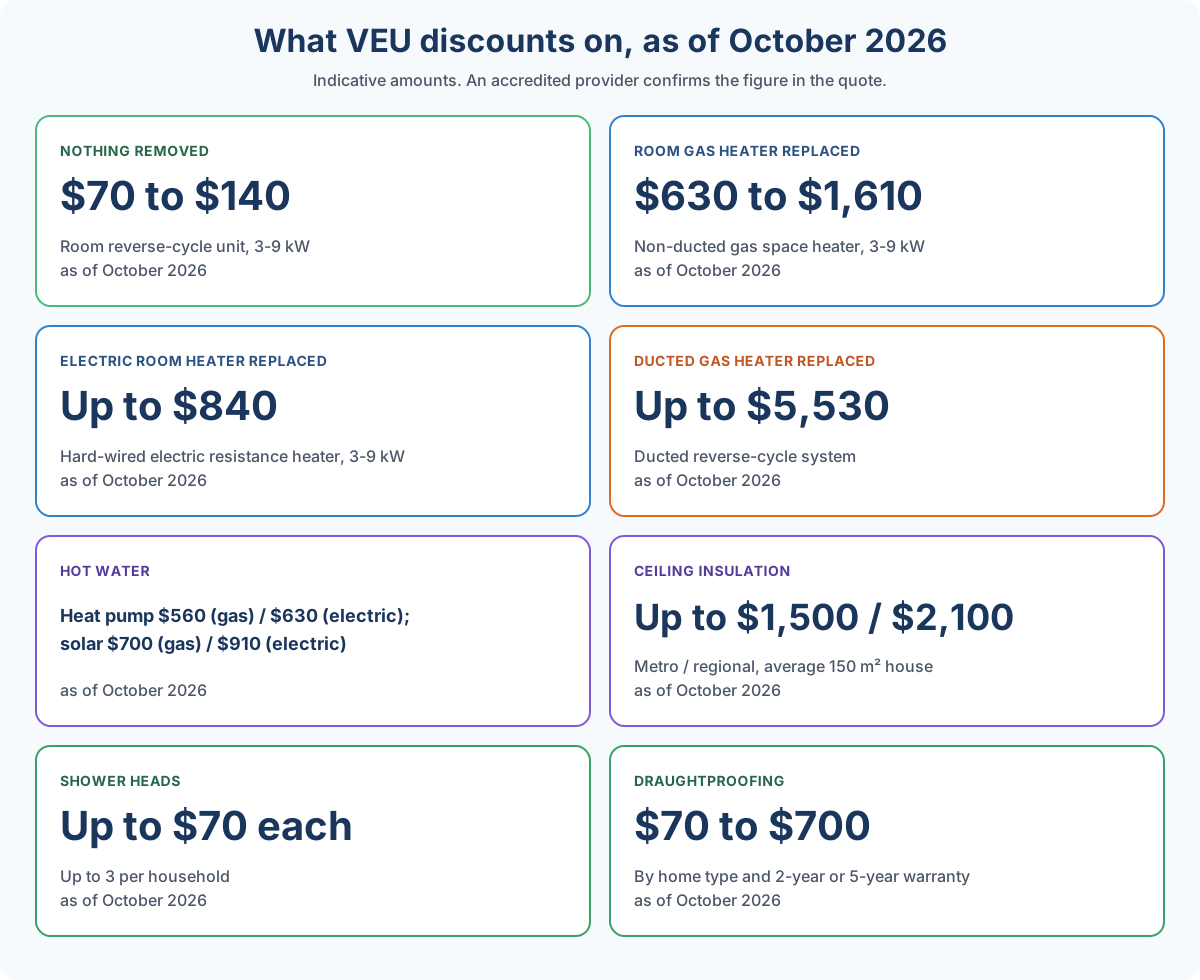
| Upgrade | Discount (as of October 2026) | More detail |
|---|---|---|
| Reverse-cycle air conditioner replacing a non-ducted gas space heater (VEU's example: a single room heater; this includes a gas wall heater) | $630 to $1,610 (3 to 9 kW) (energy.vic.gov.au) | Cooling guide |
| Ducted reverse-cycle system replacing a ducted gas heater | Up to $5,530 (energy.vic.gov.au, energy.vic.gov.au) | Cooling guide |
| Room reverse-cycle unit replacing a hard-wired electric room heater | Up to $840 (energy.vic.gov.au) | Cooling guide |
| Room reverse-cycle unit with nothing replaced | $70 to $140 (energy.vic.gov.au) | Cooling guide |
| Installing a new gas heater | No discount. Gas space heating was removed from VEU on 30 June 2023 (ESC, energy.vic.gov.au) | Heating guide |
| Hot water: heat pump replacing an electric system | $630 (energy.vic.gov.au) | Hot water guide |
| Hot water: solar-boosted replacing an electric system | $910 (energy.vic.gov.au) | Hot water guide |
| Hot water: heat pump replacing a gas system | $560 (energy.vic.gov.au) | Hot water guide |
| Hot water: solar-boosted replacing a gas system | $700 (energy.vic.gov.au) | Hot water guide |
| Ceiling insulation (uninsulated, or below R2.0) | Up to $1,500 in metropolitan Melbourne and $2,100 in regional Victoria, for an average 150 m² house (energy.vic.gov.au) | Ceiling insulation guide |
| Shower heads | Up to $70 each, up to 3 per household (energy.vic.gov.au) | Showerheads guide |
| Draughtproofing (weather sealing), 2-year or 5-year warranty | Apartment $70 or $140. Townhouse $280 or $560. House $350 or $700 (energy.vic.gov.au) | Draughtproofing guide |
The heating and cooling discount depends on the system you're replacing. Your accredited provider or installer confirms it in your quote (energy.vic.gov.au).
The ceiling insulation discount opened to all eligible Victorian homes on 1 October 2026 (ESC, CAV). The amounts vary with certificate prices, house size, location and provider costs (energy.vic.gov.au).
How much will I still pay after the discount?
Many upgrades have a minimum customer contribution. Since 30 September 2026, air conditioners have these minimums, including GST, per installed product (ESC):
| System | You pay at least (as of October 2026) |
|---|---|
| Ducted air conditioner | $3,000 |
| Multi-split, 10 kW or more | $3,000 |
| Multi-split, under 10 kW | $1,000 |
| Single split, 10 kW or more | $1,000 |
| Single split, under 10 kW | $200 |
As of October 2026, hot water systems and ceiling insulation each have a $200 minimum contribution, including GST for insulation (energy.vic.gov.au, energy.vic.gov.au).
Is the Solar Victoria hot water rebate the same as VEU?
No. It's a separate rebate from Solar Victoria, and it's only for owner-occupiers. Renters and landlords can't get it, but they can still get the VEU hot water discount (Solar Victoria, energy.vic.gov.au).
As of October 2026, it's 50% of the purchase price, up to $1,000, or up to $1,400 for eligible locally made products. It's worked out after other discounts, including VEU (Solar Victoria).
- Combined household taxable income under $150,000, from 1 July 2026 (Solar Victoria)
- Property value under $3 million (Solar Victoria)
- The system being replaced is at least 3 years old (Solar Victoria)
- The address hasn't already had a hot water or battery rebate (Solar Victoria)
How do I claim a VEU discount?
Contact an accredited provider first. Do this before you buy or install anything (energy.vic.gov.au).
Check the product rules. For heating and cooling, it must be an approved high-efficiency reverse-cycle air conditioner with at least a 5-year warranty. If it replaces an old system, the home must be more than 2 years old (energy.vic.gov.au).
Get a quote with the discount applied. The discount comes off the quote, and you pay the rest, including any minimum contribution (energy.vic.gov.au, ESC).
Renters: get your landlord's permission for heating and cooling before work starts (energy.vic.gov.au, CAV).
How do I check a provider is accredited?
Only accredited providers can apply a VEU discount. To check one, use the Essential Services Commission's VEU Public Registry: open the "Accredited Persons" report and search the business name (ESC). Each VEU discount page on energy.vic.gov.au also lists accredited providers (energy.vic.gov.au).
As of 31 October 2026, the ESC says registry reports are temporarily unavailable. Until they're back, use the provider lists on the energy.vic.gov.au discount pages (ESC, energy.vic.gov.au).
Since 1 May 2024, VEU businesses can't cold-call you, and since 1 August 2024 they can't doorknock, unless you agreed first (energy.vic.gov.au, ESC). They must also:
- tell you which business they work for
- not say they work for the Victorian Government
- not say an upgrade is mandatory
Taking part is voluntary (energy.vic.gov.au, ESC).
To report a cold call, doorknock or VEU problem, contact the ESC on (03) 9032 1310 or veu@esc.vic.gov.au. For false or misleading claims, contact Consumer Affairs Victoria on 131 450 (energy.vic.gov.au).
What other energy help is there?
If you need help paying energy bills rather than upgrading, the Victorian Government has other support:
A concession card is separate from a VEU discount. See which cards and local concessions apply in the concession cards guide.
If you can shift electricity use, the free electricity window from 11am to 2pm is a different kind of bill saving.
Utility Relief Grant: help with an overdue mains electricity, gas or water bill after a temporary financial crisis. It's for Pensioner Concession Card, Health Care Card or Veterans' Affairs Gold Card holders, and some low-income households. Renters and homeowners can apply (DFFH).
As of October 2026, the maximum is $650 per utility type in a two-year period, or $1,300 for households with a single energy source. Apply through your retailer (DFFH).
Annual electricity concession: for the same cardholders. As of October 2026, it's 17.5% off electricity usage and service costs, except the first $171.60 of the annual bill. Give your card details to your electricity retailer (DFFH).
Energy Assistance Program: as of October 2026, free one-on-one help with your energy bills on 1800 161 215. Victorian Energy Compare lets you compare electricity, gas and solar offers (energy.vic.gov.au).
Trouble paying: ask your retailer's hardship team. Under the Payment Difficulty Framework, they must tell you what help is available (energy.vic.gov.au).
Can I claim a VEU discount after I've already bought?
Only sometimes. Retrospective discounts are "only available in limited circumstances" (energy.vic.gov.au).
They must be processed within 6 months of the end of the calendar year of the upgrade. For example, a job done in December 2025 had to be submitted by 30 June 2026 (energy.vic.gov.au).
Ask an accredited provider whether your job qualifies.
How can landlords use VEU for the new rental standards?
Landlords can use the program "at any time, including emergencies such as a failed hot water or reverse cycle air conditioner" (energy.vic.gov.au).
For rental providers, energy.vic.gov.au lists, as of October 2026, up to $1,610 to replace a gas space heater with an efficient reverse-cycle air conditioner. It lists up to $5,530 to replace a ducted gas heater with a ducted system (energy.vic.gov.au).
From 1 March 2027, a new lease or a switch to month-to-month brings in the cooling, shower head and ceiling insulation standards (CAV, Regulations). See the cooling guide, or use the free rental upgrade checker for a plan for your property.
Check what your rental needsCommon questions about VEU discounts
Will the upgrade cost me nothing?
No. As of October 2026, air conditioners, hot water systems and ceiling insulation have a minimum you must pay, such as $200 for a single split system under 10 kW (ESC, energy.vic.gov.au, energy.vic.gov.au). Your provider confirms the amount in your quote (energy.vic.gov.au).
Are the discount amounts fixed?
No. They are "indicative" and "up to" amounts, and they change often. The heating and cooling page was last updated on 29 October 2026 (energy.vic.gov.au).
Can I use my own installer?
Yes, if they work with an accredited provider. Only accredited providers can apply the discount (energy.vic.gov.au, energy.vic.gov.au, energy.vic.gov.au).
Official sources checked on 31 October 2026
- CAV: New minimum energy efficiency standards (last updated 21 October 2026)
- CAV: Minimum standards for rental properties (last updated 14 October 2026)
- CAV: Renters making changes to the property (last updated 13 October 2026)
- energy.vic.gov.au: Energy efficiency for rental properties in Victoria (last updated 9 October 2026)
- energy.vic.gov.au: VEU heating and cooling discounts (last updated 29 October 2026)
- energy.vic.gov.au: VEU for renters, landlords and body corporate (last updated 28 August 2026)
- energy.vic.gov.au: About Victorian Energy Upgrades (last updated 13 October 2026)
- energy.vic.gov.au: VEU retrospective discounts (last updated 14 October 2026)
- energy.vic.gov.au: Victorian Energy Upgrades for homes (last updated 15 October 2026)
- Residential Tenancies Regulations 2021, in-force version 009 (version 009, in force from 30 June 2026)
- ESC: Changes to space heating and cooling incentives and consumer co-payments from 30 September 2026 (published 30 September 2026)
- ESC: Updates to the VEU program (latest update 1 October 2026)
- ESC: Water heating, space heating and cooling, weather sealing and HERA updates (2023) (no update date shown)
- energy.vic.gov.au: VEU hot water system discounts (last updated 26 October 2026)
- energy.vic.gov.au: VEU ceiling insulation discounts (last updated 21 October 2026)
- energy.vic.gov.au: VEU shower head discounts (last updated 12 October 2026)
- energy.vic.gov.au: VEU weather sealing discounts (last updated 14 October 2026)
- energy.vic.gov.au: VEU products (no update date shown)
- Solar Victoria: Hot water rebate (last updated 27 October 2026)
- Solar Victoria: Solar Homes Program continuing to provide targeted assistance (last updated 29 October 2026)
- ESC: Find an accredited provider (VEU Public Registry) (no update date shown; registry reports temporarily unavailable on 31 October 2026)
- ESC: Your consumer rights under the VEU program (no update date shown)
- energy.vic.gov.au: Telemarketing and door knocking under the VEU program (last updated 5 August 2024)
- energy.vic.gov.au: Your rights under VEU (last updated 5 August 2024)
- DFFH: Utility Relief Grant Scheme (last updated 14 July 2023)
- DFFH: Annual electricity concession (last updated 1 May 2026)
- energy.vic.gov.au: Help paying your energy bills (last updated 20 August 2026)
General information only: This guide is not legal or financial advice and is not from a government agency. Discounts and rules can change. Check the linked official pages and ask an accredited provider before you act.
In NSW? See our NSW Home Energy Saver discount guide.