Working Holiday Visa Tax Rates, Tax Return and Super
Do I pay tax and get super on a working holiday visa?
Usually yes to both, but the details depend on your taxable income, whether your employer is registered as a WHM employer, whether you gave them your TFN, any other income or study loan, and, in a few cases, your residency and nationality. Most employees are eligible for super, with some exceptions, and tax is taken when you claim it.
Content record as of November 2026. Individual source-check dates, effective dates and scenario assumptions below still apply.
As of October 2026, most working holiday makers on a 417 or 462 visa pay 15% tax on the first $45,000 of taxable income, then 30% up to $135,000. Your employer must also pay super. You claim it after you leave Australia and your visa has ended, and 65% tax is taken from the taxable part.
In this guide
Check your own situation. This guide is general information based on ATO pages checked on 20 October 2026.
It covers tax and super only. For visa rules, see our working holiday visa guide. Your income statement and ATO online account show your own figures.
How much tax do working holiday makers pay in Australia?
If you hold a working holiday visa (subclass 417) or a work and holiday visa (subclass 462), you are a working holiday maker (WHM).
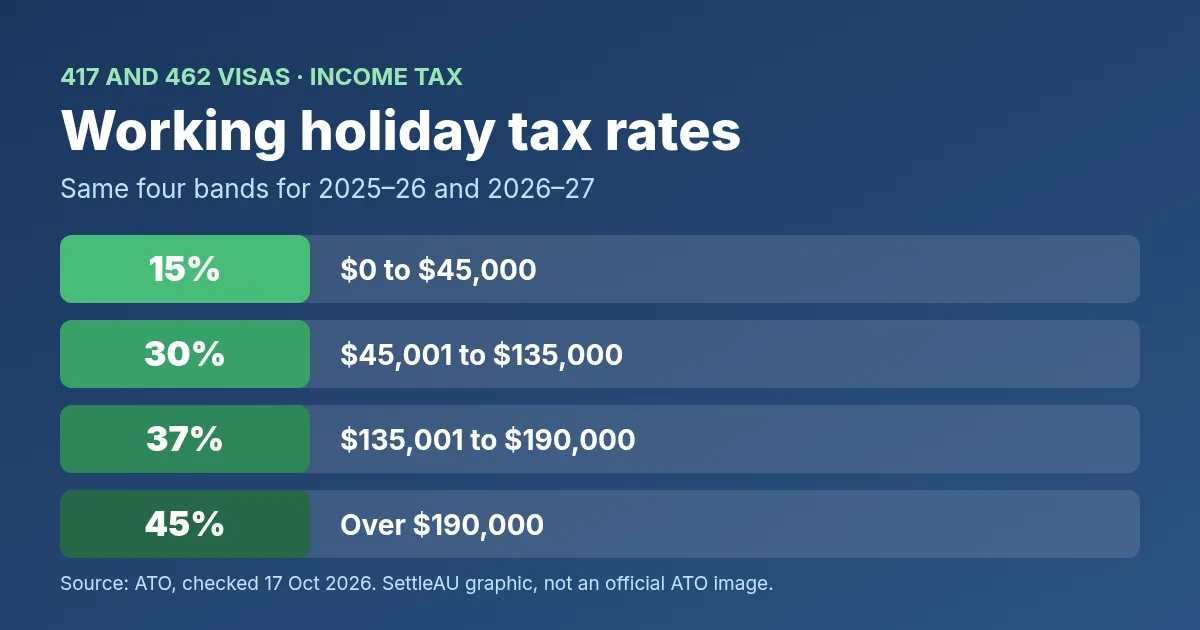
Your income is taxed in four bands. The ATO’s table for 2025–26 is below, with rates as of October 2026.
The bands are the same for 2026–27: the Income Tax Rates Act 1986 and the ATO’s Schedule 15 withholding table both show 15%, 30%, 37% and 45% with the same limits (as of October 2026). The ATO’s rates page listed 2025–26 as its latest year when we checked, so use Schedule 15 for 2026–27.
| Taxable income | Tax on this income | Rate on this band |
|---|---|---|
| $0 – $45,000 | 15c for each $1 | 15% |
| $45,001 – $135,000 | $6,750 plus 30c for each $1 over $45,000 | 30% |
| $135,001 – $190,000 | $33,750 plus 37c for each $1 over $135,000 | 37% |
| Over $190,000 | $54,100 plus 45c for each $1 over $190,000 | 45% |
- It is not a flat 15%. As of October 2026, the 15% rate applies only to the first $45,000 of taxable income.
- There is no tax-free threshold in these rates, so tax starts with your first dollar.
- Medicare levy: the ATO says foreign residents are not required to pay the Medicare levy. See the ATO’s foreign resident rates page.
- Example 1 (rates as of October 2026): $30,000 of taxable income × 15% = $4,500 tax.
- Example 2 (rates as of October 2026): $50,000 of taxable income: $6,750 on the first $45,000, plus 30% of the next $5,000 ($1,500) = $8,250 tax.
The examples assume all your taxable income is working holiday maker income and leave out offsets and other income. They are not a refund estimate. For your own numbers, try our tax calculator or the ATO’s tools.
How much tax will my employer take out of my pay?
- Registered employer: as of October 2026, the ATO says if your employer is registered as a WHM employer, they withhold 15% on the first $45,000 you earn in the income year. Higher rates apply above that.
- Employer not registered: they must use the foreign resident rates, which start at 30% (as of October 2026). For example, 30% on $1,000 is $300.
- No TFN: without a tax file number, the ATO says you pay more tax, and its withholding table tells employers to withhold 45% (as of October 2026). Apply for a TFN once you have your visa. See our TFN guide.
- Your employer registers, not you. WHMs don’t need to register themselves. Tell your employer you are on a 417 or 462 visa and give them a TFN declaration.
Withholding is a prepayment, not your final tax. Your tax return, or the rules for not lodging, decide the final result.
Do I need to lodge a tax return on a working holiday visa?
Often yes, but there is one exception (unless you have a study or training loan: see below). You don’t need to lodge a tax return or a non-lodgment advice if both of these apply:
- All your income was earned as salary or wages while you were a working holiday maker.
- Your total taxable income for the income year was less than $45,001 (this applies to 2020–21 and later income years; as of October 2026).
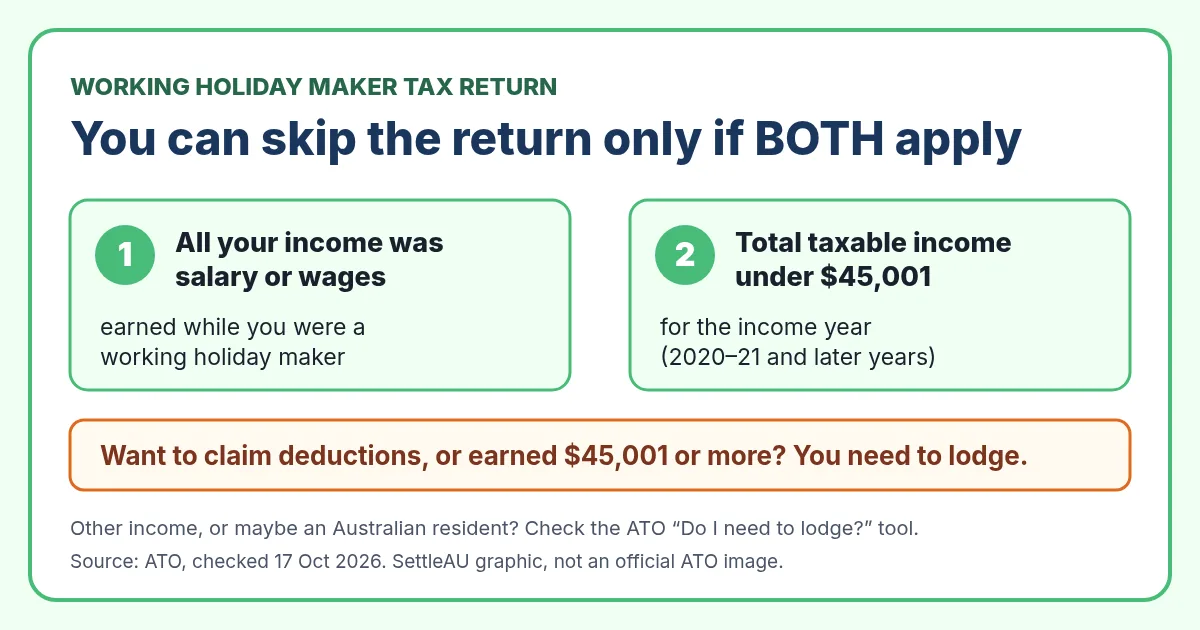
- If your taxable income was $45,001 or more (as of October 2026), you must lodge.
- If you want to claim deductions, you need to lodge. If you are under the threshold you can still choose to lodge.
- If you had other income, such as interest or self-employment, or you may be an Australian resident, check the ATO’s Do I need to lodge? tool. Our guide does not decide this for you.
- You may also want to lodge if you think you are an Australian resident from one of the treaty countries listed below.
Dates for 2025–26: as of November 2026, the ordinary due date for a return you lodge yourself has passed. It was Monday 2 November 2026, because 31 October was a Saturday and the ATO moves a weekend due date to the next business day.
If the ATO has granted you extra time to lodge, follow that lodgment date. Do not assume a request for extra time, or extra time to pay, changes your lodgment deadline; confirm with the ATO.
myGov tax support guidance says the ATO may give extra time to lodge depending on your circumstances. This is not automatic. This guidance was checked on 2 November 2026.
If you have not lodged, lodge as soon as you can and contact the ATO. A later tax-agent due date applies only if you were on a registered agent’s client list by 31 October 2026. See the ATO pages on preparing your tax return, adding clients by 31 October and the failure to lodge on time penalty.
Your tax bill, if you have one, is due on the date on your notice of assessment. Read our first tax return guide for the full steps and payment wording.
Leaving Australia for good? The ATO says you can lodge before you leave, or from overseas with a myGov account linked to the ATO. See ATO foreign and temporary residents.
Study or training loan (HELP, VSL or AASL): if you are a foreign resident with one of these debts, the ATO says you need to report your worldwide income, or lodge a non-lodgment advice if your worldwide income is $16,750 or less (2025–26, as of October 2026).
This can apply even if the working holiday maker exception above would otherwise cover you, so don’t assume you can skip lodging.
Check the ATO’s Do I need to lodge? tool or ask a registered tax agent. See the ATO page on overseas obligations when repaying loans.
The ATO also says that if you were a foreign resident, had a HELP, VSL or AASL debt on 1 June 2025, and your repayment income plus any foreign-sourced income was more than $16,750 (as of October 2026), you must lodge your 2025–26 tax return electronically, even if one of its other reasons applies to you.
See the ATO’s Do you need to lodge a tax return? 2026 page (Reason 5).
Does being a resident or foreign resident change my tax?
Usually not. The ATO says that for most WHMs, being an Australian resident or a foreign resident for tax purposes doesn’t affect the rate of tax you pay.
Most people on a working holiday are foreign residents. The ATO’s longstanding view is that WHMs are foreign residents, but your own facts decide it. See Australian residency if you’re on a working holiday or visit and our visa-holder tax guide.
The Medicare levy is separate. The ATO says foreign residents don’t pay it. If you are an Australian resident for tax, check the ATO’s Medicare levy pages.
The exception: you may be taxed on the same basis as a resident Australian national if you are an Australian resident for tax purposes and a national of one of these countries: Chile, Finland, Germany, Israel, Japan, Norway, Turkey or the United Kingdom.
The ATO says you pay the lower amount of tax from the two ways of assessing you. Your employer still withholds 15% (as of October 2026).
If you describe yourself as a resident, the ATO may review it. If it disagrees, WHM rates apply. See the ATO page on resident WHMs from non-discrimination article countries.
Does my employer have to pay super on a working holiday visa?
Yes, generally. The ATO says that as a WHM, your employer also has to pay superannuation.
Its super page says generally all employees are eligible for the super guarantee, including a temporary resident such as a backpacker, with some exceptions.
The super guarantee rate is 12% from 1 July 2025 (still 12% as of October 2026). Under Payday Super, the ATO says it is worked out on the qualifying earnings paid to you for each pay period.
The ATO says qualifying earnings include your ordinary time earnings (pay for your ordinary hours of work), all commissions, and salary you sacrifice to super that would otherwise have counted. Overtime is generally not included.
- Where it goes: into a super fund. Most employees can choose the fund. If you worked for several employers you may have more than one account.
- Payday Super (from 1 July 2026): your employer pays super each payday. Your fund must generally receive it within 7 business days after payday to be on time (20 business days for the first contribution for a new employee). Before 1 July 2026, employers had 28 days after the end of each quarter.
Check it was paid. Your income statement shows the super that has been paid. You can see it in ATO online services through myGov.
Ask your employer about any gap before you claim.
For general super basics, see our new-job super checklist.
Can I get my super back after a working holiday?
Often, yes. You claim it as a departing Australia superannuation payment (DASP).
You claim your super after you leave Australia and your visa has ended. Start before you go.
The ATO says you can generally claim a DASP if all of these apply:
- you built up super while working in Australia on a temporary visa (some visa types are excluded);
- your visa has ended (expired or cancelled);
- you have left Australia and hold no other active Australian visa; and
- you are not an Australian or New Zealand citizen, or an Australian permanent resident.
How do I start?
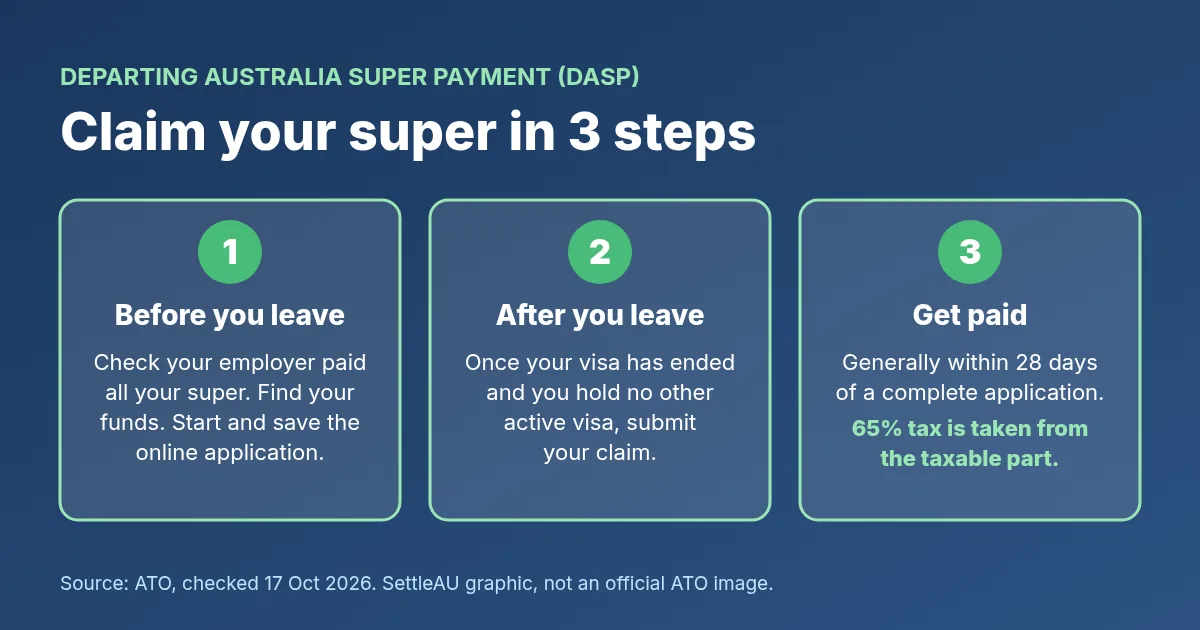
- Before you leave: check your employer paid all your super, and find your fund or funds. The ATO says to start your application before you leave because it can be hard to start once you are overseas. You can start and save the DASP online application system (free) while you are still in Australia.
Keep your details: note what you enter. You need the same details to resume the application after you leave.
As of October 2026, if your balance in a fund is $5,000 or more, that fund may need certified copies of your ID, which is easier to arrange in Australia. Check with each fund which documents it needs.
If you apply on paper instead, the fund will require certified copies of your ID, and for $5,000 or more (as of October 2026) it may also need a Home Affairs Certification of Immigration Status (there is a fee).
- After you leave: you can only submit once you have left and hold no active visa. See our leaving Australia super guide for the checks before you claim.
Getting paid: the ATO says a DASP is generally paid within 28 days of a complete application. Payment is by transfer to an Australian bank account or an Australian dollar cheque.
International transfer is only for super held by a fund (not super held by the ATO), not every fund offers it, and fees and currency conversion charges may apply. Keeping your Australian bank account open is usually easiest.
How much tax is taken?
A final tax is withheld when the payment is made. As of October 2026, the ATO says the working holiday maker rate is 65% of the taxable component. The table shows the rates for each part.
| Part of your payment | If you have held a WHM visa | Other temporary visa holders |
|---|---|---|
| Tax-free component | Nil | Nil |
| Taxable component: taxed element | 65% | 35% |
| Taxable component: untaxed element | 65% | 45% |
- Each fund decides separately. If a payment from a fund includes super paid while you held a 417 or 462 visa, the WHM rate applies to the whole payment from that fund. It doesn’t matter when you held the visa.
- Example (illustration only, rate as of October 2026): if a fund pays you $5,000 and all of it is a taxable component taxed at 65%, $3,250 is withheld and $1,750 is paid to you. Your fund will tell you the actual split.
- Payment summary: the payer must give you a DASP payment summary within 14 days.
- Don’t put it in your tax return. DASP isn’t part of your assessable income, because final tax is withheld.
- If you don’t claim: if 6 months or more have passed since you left and your visa has ended, your fund transfers your super to the ATO as unclaimed super. You may still claim ATO-held super as a DASP.
- Future visas: the ATO says claiming a DASP will not affect future visa applications.
Common questions about working holiday tax and super
How much tax do working holiday makers pay in Australia?
As of October 2026, working holiday makers on a 417 or 462 visa pay 15% on the first $45,000 of taxable income, 30% from $45,001 to $135,000, 37% from $135,001 to $190,000 and 45% above $190,000.
These bands are the same for 2025–26 and 2026–27. It is not one flat 15% on everything you earn.
Do I need to lodge a tax return if I earn less than $45,001?
You don't need to lodge a tax return or a non-lodgment advice if both of these apply: all your income was salary or wages earned while you were a working holiday maker, and your total taxable income for the year was less than $45,001 (as of October 2026).
You can still choose to lodge, and you need to lodge if you want to claim deductions. If you had other income, check the ATO's lodgment tool.
If you are a foreign resident with a HELP, VSL or AASL study or training loan debt, don't assume you can skip lodging: the ATO says you need to report your worldwide income, or lodge a non-lodgment advice if your worldwide income is $16,750 or less (2025–26, as of October 2026).
The ATO also says that if you were a foreign resident, had a HELP, VSL or AASL debt on 1 June 2025, and your repayment income plus any foreign-sourced income was more than $16,750 (as of October 2026), you must lodge your 2025–26 tax return electronically, even if one of its other reasons applies to you.
Can I get my super back after a working holiday?
Often, yes. You claim it as a departing Australia superannuation payment (DASP) after you leave Australia and your visa has ended.
You can start the online application before you go. As of October 2026, 65% tax is taken from the taxable part of the payment, so you don't get back the whole balance.
How long does it take to get my super after I leave?
The ATO says a DASP is generally paid within 28 days of a complete application. It can take longer if your application is incomplete or the fund needs more documents. Keeping an Australian bank account open is usually the easiest way to receive the payment.
Is my tax rate different if I am an Australian resident for tax?
For most working holiday makers, being a foreign resident or an Australian resident does not change the rate.
The exception is an Australian resident for tax who is a national of Chile, Finland, Germany, Israel, Japan, Norway, Turkey or the United Kingdom. They may pay tax at resident rates, using the lower result.
Most working holiday makers are foreign residents, and your own facts decide it.
The Medicare levy is separate: the ATO says foreign residents don't pay it. If you are an Australian resident for tax, check the ATO's Medicare levy pages.
What happens if I don't give my employer my tax file number?
The ATO says that without a tax file number you pay more tax. The ATO's withholding table for working holiday makers tells an employer to withhold 45% (as of October 2026) if no TFN has been given. Apply for a TFN once you have your visa and give your employer a TFN declaration.
Official sources checked on 20 October 2026
- ATO: Working holiday makers (page updated 3 June 2026)
- ATO: Tax rates – working holiday maker (page updated 1 June 2026; lists 2025–26 as the latest year)
- ATO: Schedule 15 – Tax table for working holiday makers (published 17 June 2026; for payments from 1 July 2026; written for employers)
- Federal Register of Legislation: Income Tax Rates Act 1986, Schedule 7 Part III (compilation of 1 July 2026)
- ATO: Tax rates – foreign resident (page updated 1 June 2026)
- ATO: Australian residency if you’re on a working holiday or visit (page updated 3 June 2026)
- ATO: Taxation of Australian resident WHMs from NDA countries (page updated 3 June 2026)
- ATO: Lodge a non-lodgment advice (page updated 31 August 2026)
- ATO: Do you need to lodge a tax return? 2026 (page updated 30 May 2026)
- ATO: Preparing your tax return (page updated 27 April 2026)
- ATO: Foreign and temporary residents (page updated 3 June 2026)
- ATO: Super from your employer (page updated 1 July 2026)
- ATO: How to work out and pay super (Payday Super) (page updated 20 October 2026; written for employers)
- ATO: What payments are qualifying earnings (page updated 2 September 2026; written for employers)
- ATO: Overseas obligations when repaying loans (page updated 13 October 2026)
- ATO: Medicare levy
- ATO: Payment deadlines for Payday Super (page updated 29 September 2026)
- Home Affairs: Form 1194 Certification of Immigration Status
- ATO: Departing Australia superannuation payment (DASP) (page updated 21 April 2026)
- ATO: DASP online application system
General information only: This guide is not tax, financial, super or migration advice and is not from the ATO. Rates, dates and ATO pages can change. Check the linked ATO pages and your own ATO online account before you act.