Your First Australian Tax Return: The 2 November 2026 Deadline Has Passed
How should you prepare your first Australian tax return?
Use this checklist for your 2025–26 return (1 July 2025 to 30 June 2026). It helps you check readiness, prepare records and review myTax; it cannot decide your tax residency or promise a refund.
Content record as of November 2026. Individual source-check dates, effective dates and scenario assumptions below still apply.
As of November 2026, the ordinary self-lodgment deadline for 2025–26 has passed: Monday 2 November 2026. If the ATO granted you extra time to lodge, follow that date; otherwise, lodge promptly and contact the ATO. Later tax-agent program dates require being on the agent’s client list by 31 October.
In this guide
Check your own situation. This guide is general information based on ATO pages checked on 21 October 2026.
It can’t decide your tax residency or promise a refund. Your ATO online account shows the dates that apply to you.
Do I need to lodge my first Australian tax return?
Most people who earn income in Australia and have tax withheld need to lodge a tax return for the income year, which runs from 1 July to 30 June. This guide covers the 2025–26 year (1 July 2025 to 30 June 2026). The ATO has a free tool to work out if you need to lodge.
- The ATO says you usually don’t need to lodge if your income is under the tax-free threshold ($18,200 as of October 2026) and no tax was withheld. Some circumstances still require a return, so use the tool.
- Foreign residents for tax purposes have no tax-free threshold. As of October 2026, the ATO says a foreign resident with $1 or more of Australian taxable income must lodge a return.
Working holiday makers have one exception. You don’t need to lodge a tax return or a non-lodgment advice if both of these apply:
- all your income was salary or wages earned while you were a working holiday maker, and
- your total taxable income for the year was less than $45,001 (as of October 2026).
You can still choose to lodge, and you need to lodge if you want to claim deductions.
If you are a foreign resident with a HELP, VSL or AASL debt, the ATO says you need to report your worldwide income or lodge a non-lodgment advice, even if this exception would otherwise cover you. The ATO’s foreign and temporary residents page says the same. Check the ATO’s Do I need to lodge? tool.
- Your tax residency is not the same as your visa. The ATO uses its own residency tests. You can have a visa and still not be an Australian resident for tax purposes.
- If you don’t need to lodge, tell the ATO with a non-lodgment advice so it doesn’t send reminders.
On a working holiday visa or another temporary visa? Read our visa-holder tax decision guide first. It explains residency and the working holiday maker rules in more detail.
Working holiday maker tax rates and how to claim super after you leave are in our working holiday visa tax and super guide.
When is my 2025–26 tax return due?
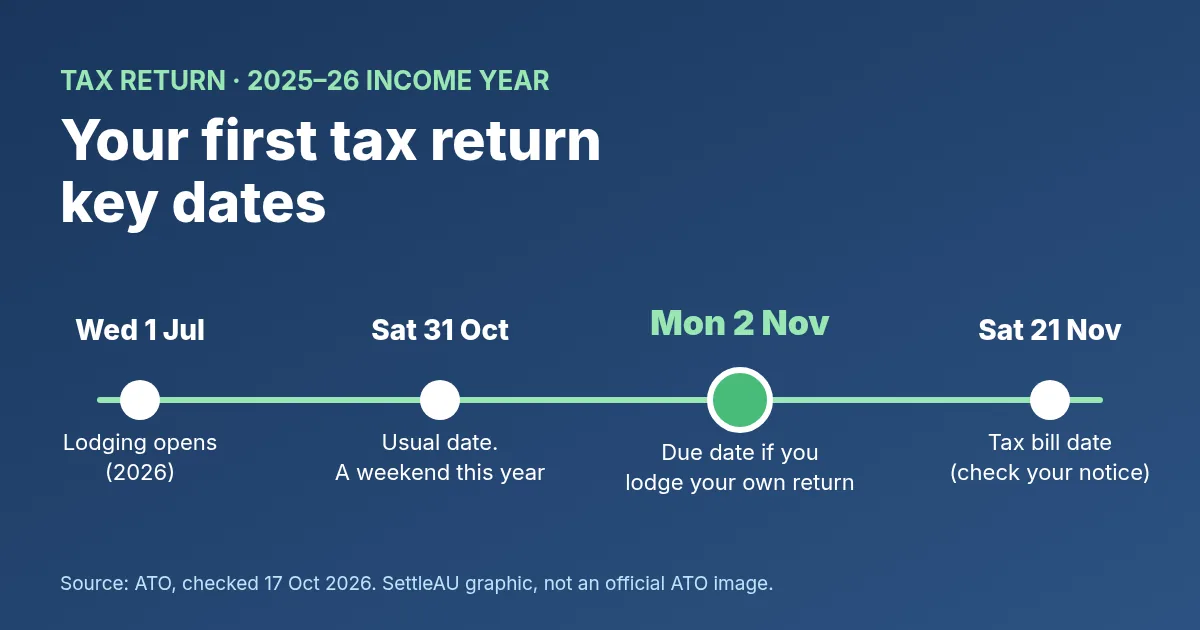
As of November 2026, the ordinary due date for a 2025–26 return you lodge yourself has passed. The ATO says you normally have from 1 July to 31 October. In 2026, 31 October was a Saturday.
The ATO says that when 31 October falls on a weekend, the due date is the next business day. That made the due date Monday 2 November 2026. From 3 November, a return you lodge yourself is late unless the ATO has granted you extra time to lodge.
If the ATO has granted you extra time to lodge, follow that lodgment date. Do not assume a request for extra time, or extra time to pay, changes your lodgment deadline; confirm with the ATO.
myGov tax support guidance says the ATO may give extra time to lodge depending on your circumstances. This is not automatic. This guidance was checked on 2 November 2026.
| Date | What happens | Source |
|---|---|---|
| Wed 1 Jul 2026 | You can start lodging your own 2025–26 return. Wait until your income statement is “tax ready”. | ATO: Lodge your first tax return |
| Sat 31 Oct 2026 | This was the usual lodgment date, and the cut-off for a registered tax agent to add a new client. The ATO told agents the weekend rule did not move that cut-off to the next business day. A later lodgment-program date applies only if you were already on the list by 31 October. | ATO: Lodge with a registered tax agent ATO newsroom for tax professionals (3 Sep 2026) |
| Mon 2 Nov 2026 | This was the due date for a return you lodge yourself, under the ATO’s weekend rule (next business day). Lodging on this day was on time. From 3 November, a self-lodged return is late unless the ATO has granted extra time to lodge. | ATO: Preparing your tax return |
| Sat 21 Nov 2026 | Your tax bill is due on the date on your notice of assessment. The ATO says that if you lodge on time, your bill is due on the later of 21 November 2026 and 21 days after your notice of assessment. If you lodge late, the ATO says it is due 21 November 2026. 21 November is a Saturday, so if you already know your amount, pay by Friday 20 November to be safe. | ATO: Preparing your tax return ATO: myTax 2026 estimate ATO: Why you may receive a tax bill |
Why the date was 2 November: no ATO page prints “2 November 2026”. The ATO’s Preparing your tax return page says that when 31 October falls on a weekend, the due date is the next business day. 31 October 2026 was a Saturday, so that day was Monday 2 November.
If your lodgment due date has passed, act now. Lodge in myTax as soon as you can, and contact the ATO. The failure to lodge on time penalty can apply.
The ATO’s Preparing your tax return page says to contact them as soon as possible if you miss the date.
A registered tax agent can still prepare the return. The later lodgment-program date applies only if you were on their client list by 31 October 2026.
What do I need to prepare before I lodge?
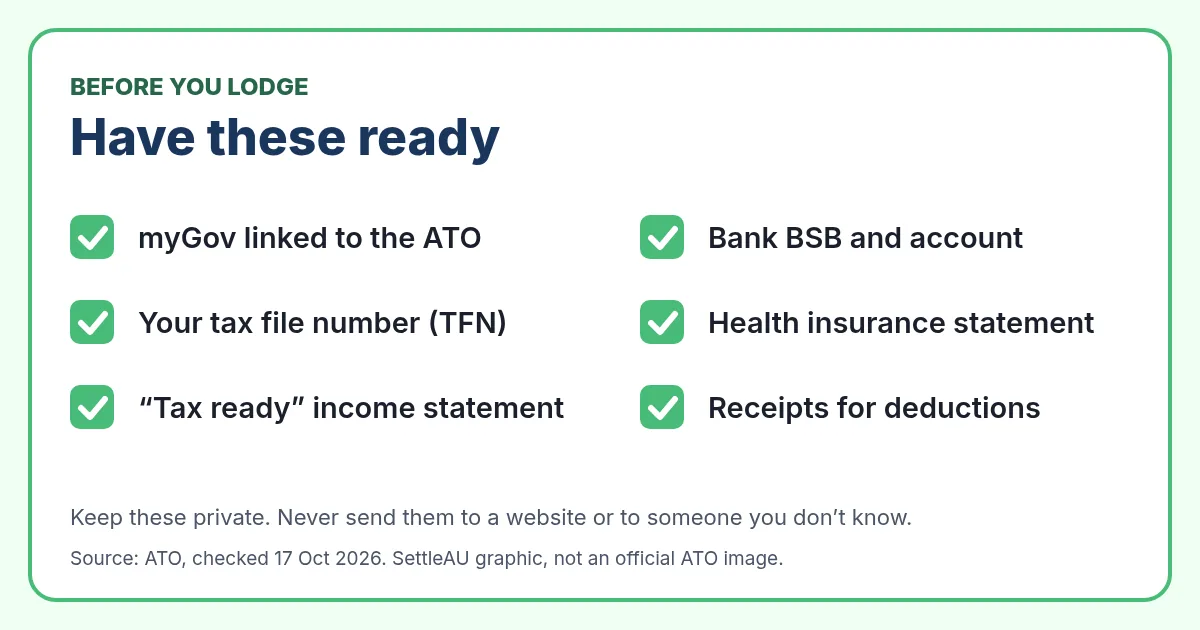
The ATO recommends you have this information ready. If you lodge online with myTax, the ATO pre-fills most of it for you, but you still need to check it.
- Your income statement, or payment summaries, from all your employers.
- Payment summaries from Centrelink (Services Australia), if you received payments.
- Your bank account details (BSB and account number) for a refund.
- Receipts or statements for expenses you are claiming as deductions.
- Your spouse’s income, if you have a spouse, and private health insurance details if you have cover.
- A myGov account linked to the ATO, and your tax file number. If you don’t have a TFN yet, see our TFN guide. If you can’t sign in, read our myGov sign-in help.
- In your arrival or departure year: keep your travel dates, accommodation and employment history. Tax residency can start on a different date from your arrival date.
- Foreign income: Australian residents for tax purposes generally declare worldwide income. A temporary resident declares income earned in Australia, capital gains on taxable Australian property, and in some cases income from work done overseas while a temporary resident. Check the ATO page on foreign and temporary residents.
Medicare levy exemption: if you plan to claim one because you were not entitled to Medicare benefits, you need a Medicare Entitlement Statement (MES) first.
As of October 2026, the ATO says it can take up to 8 weeks and you must wait for it before you lodge. Services Australia says it can take up to 8 weeks if you apply between July and November (as of October 2026). You apply through Services Australia.
An MES alone doesn’t mean you are exempt. All your dependants, including a spouse, must also be exempt. See the ATO page on not entitled to Medicare benefits.
If this may stop you lodging by the due date, contact the ATO or a registered tax agent early.
Should I wait until my income statement says “tax ready”?
Yes, if you can. The ATO recommends waiting until each income statement shows Tax ready, because your employer may change the amounts when they finalise it. If it shows a red Not tax ready box, ask your employer when they will finalise it.
- If you lodge before it is tax ready, you must review and confirm the pre-filled amounts yourself.
- If your employer finalises different amounts, you may need to amend your tax return and additional tax may be payable.
- If your employer can’t make the statement tax ready, they must give you a payment summary. If your employer is no longer in business, you estimate your income and tax withheld.
- Missing pre-fill doesn’t make income tax-free. Bank interest and other data can arrive later, so check them against your own records.
See the ATO page on an income statement that is not tax ready for your options.
How do I lodge my first tax return in myTax?
- Sign in. Go to my.gov.au, sign in, and open the linked ATO service. Choose the 2026 income year (1 July 2025 to 30 June 2026).
- Check your details. Check your personal details, your residency and the questions that decide which income sections you see. Don’t copy a friend’s answers just because you share a visa.
- Check your income. Match every income source and every amount of tax withheld with your records. Add any income that is missing.
- Add deductions. Enter only expenses you can support with records, and only the work-related part of mixed-use costs.
- Answer the Medicare, health insurance and study loan questions. Use your annual statements.
- Review, submit and save. Read the estimate and declaration, check your refund or debt details, submit only when everything is correct, and save the receipt.
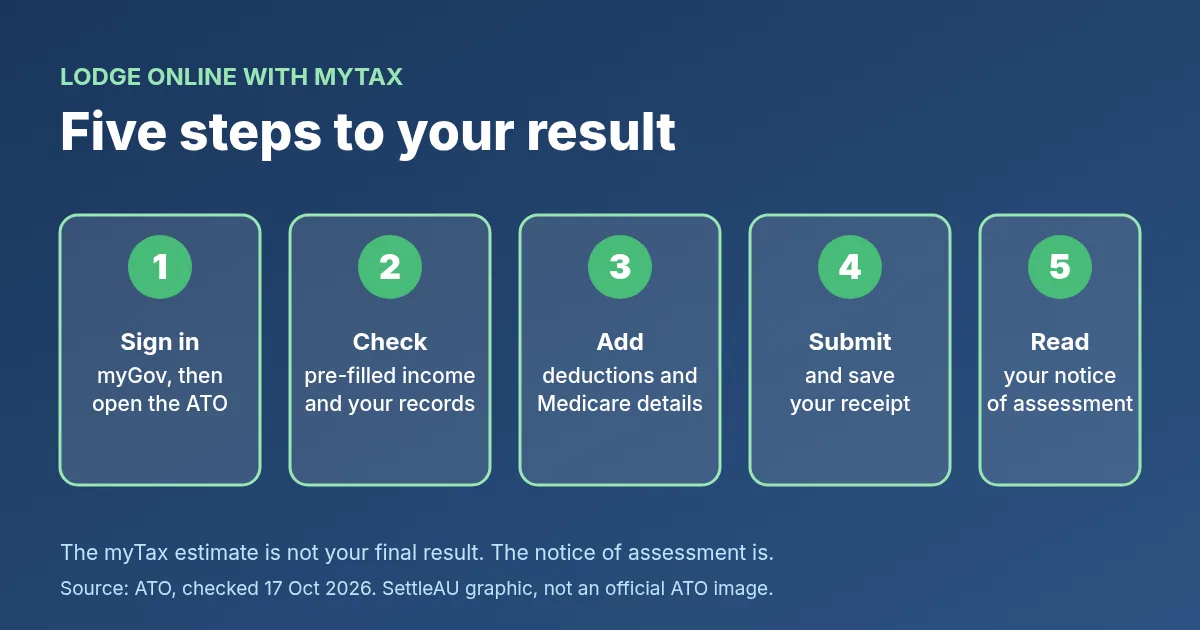
The ATO says the myTax estimate is an estimate only. It can differ from your final assessment, for example if the ATO finds a difference with the data it holds, or if you lodged before all pre-fill was available. Your notice of assessment is the final statement.
What can I claim as a deduction?
For work-related expenses you generally must have paid the cost yourself, not been repaid by your employer, spent it to earn income, and kept evidence. Ordinary travel to and from work, and everyday clothes, are generally private costs.
Working from home: for 2025–26 the fixed rate is 70 cents per work hour (as of October 2026).
You need a record of the actual hours you work from home across the whole year (the ATO says an estimate isn’t acceptable), plus at least one record for each type of running cost the rate covers, such as one electricity bill and one internet bill.
The rate includes internet, phone, energy, stationery and computer consumables, so don’t claim those separately.
The ATO says you can claim the decline in value of items such as a desk or computer separately. Claim only the work-related part, and keep records from the time you buy them.
- Items costing $300 or less (as of October 2026): you can claim an immediate deduction if you use the item mainly to produce non-business income. You still need records. This doesn’t apply if the item is part of a set, or one of several identical items, that together cost more than $300.
- No standard deduction this year: as of October 2026, the ATO says the proposed $1,000 instant tax deduction for work-related expenses does not apply to 2025–26 returns.
Worked example (rate as of October 2026): you recorded 420 hours of home work in 2025–26 and kept the required evidence.
- 420 × $0.70 = $294. That reduces your taxable income by $294.
- It is not a $294 refund.
- If your tax rate on that income were 30%, your tax would fall by $88.20.
Other items such as levies and offsets can change the result.
See the ATO pages on the fixed rate method and what is new for individuals.
What happens after I lodge?
- Your notice of assessment: the ATO sends it to your myGov inbox when it processes your return. It shows your refund or tax bill and the payment date. If there is a statement of account, the payment advice is on that.
How long it takes: the ATO aims to process myTax returns within 12 business days (as of October 2026). Paper returns are slower, and returns that need checks can take longer.
Neither a refund nor a particular date is guaranteed. You can check progress in the ATO’s self-help services.
- A refund is paid to the Australian bank account you gave in your return.
A tax bill: pay by the due date on your notice. A lodgment deadline is not a payment deadline.
Check the due date and payment details in your myGov inbox.
If you can’t pay on time, contact the ATO before the due date. You may be eligible to set up a payment plan.
A mistake: don’t lodge a second original return. Use the ATO’s amendment process.
As of October 2026, the ATO says individuals generally have 2 years to amend, starting the day after your notice of assessment is sent. Sole traders have 4 years for 2024–25 and later years. See the ATO’s time limits on amendments.
What if I miss the lodgment date?
Lodge as soon as you can. If you have not lodged, contact the ATO as soon as possible.
The ATO says it generally doesn’t apply penalties in isolated cases of late lodgment, and it generally doesn’t issue a penalty notice for a late return that results in a refund or nil.
If a penalty does apply to an individual, the ATO’s base amount is one penalty unit for every 28 days, or part of 28 days, the return is overdue, up to 5 penalty units (as of November 2026). See the ATO’s failure to lodge on time penalty page.
If you expect a tax bill, don’t delay lodging. Interest (the ATO’s general interest charge) can apply to any amount still owing after your payment due date (21 November if you lodge late).
The charge is worked out daily and compounds, and the ATO reviews the rate each quarter. See the ATO pages on general interest charge and what happens if you don’t lodge.
Should I use a tax agent or Tax Help?
Tax Help (free): the ATO’s volunteers help eligible people lodge online from July to October.
As of October 2026, you may be eligible if your income is around $70,000 or less and your tax affairs are simple, for example no business income, rental property or foreign income (other than a foreign pension).
Phone the ATO on 13 28 61 (select option 2, then option 3) to find a service. See the Tax Help program.
A registered tax agent: only registered tax agents can charge a fee to prepare your return.
Check the agent on the Tax Practitioners Board register and ask what the fee covers.
As of November 2026, a later lodgment-program date applies only if you were on their client list by 31 October 2026. Hiring an agent after that date does not give you that later date. They can still lodge the return for you.
- Tax calculator: to estimate your tax first, try our tax calculator. It is an estimate, not your assessment.
Which next step is right for me?
- A simple return with every income statement tax ready: lodge it yourself in myTax using the ATO’s myTax instructions 2026.
- Foreign assets, a change of residency, mixed income or you’re unsure: use a registered tax agent. Get a fee quote first. Paying an agent doesn’t guarantee a bigger refund.
- Leaving Australia this year: our visa-holder tax guide also covers tax steps before you leave.
Common questions about your first tax return
Do all new migrants need to lodge a tax return?
No single rule covers everyone. Most people who earn income in Australia and have tax withheld need to lodge.
As of October 2026, a foreign resident with $1 or more of Australian taxable income must lodge, with an exception for some working holiday makers (check the ATO's rules if you have a HELP, VSL or AASL study or training loan).
Use the ATO tool “Do I need to lodge a tax return?” for the year. If you don't need to lodge, tell the ATO with a non-lodgment advice.
When is my first Australian tax return due in 2026?
As of November 2026, the ordinary due date for a 2025–26 return you lodge yourself has passed. It was Monday 2 November 2026, because 31 October was a Saturday and the ATO moves a weekend due date to the next business day.
If you have not lodged, lodge as soon as you can and contact the ATO. A later tax-agent date applies only if you were on a registered agent's client list by 31 October 2026.
If the ATO has granted you extra time to lodge, follow that lodgment date. Do not assume a request for extra time, or extra time to pay, changes your lodgment deadline; confirm with the ATO.
What if I missed the deadline?
Lodge as soon as you can. If you have not lodged, contact the ATO as soon as possible.
The ATO says it generally doesn't apply penalties in isolated cases of late lodgment, and it generally doesn't issue a penalty notice for a late return that results in a refund or nil.
If a penalty does apply to an individual, the base amount is one penalty unit for every 28 days, or part of 28 days, up to 5 penalty units.
If you expect a tax bill, don't delay: interest can apply to any amount you owe after your payment due date.
When do I have to pay my tax bill?
Your tax bill is due on the date on your notice of assessment.
The ATO says that if you lodge on time, your bill is due on the later of 21 November 2026 and 21 days after your notice of assessment. If you lodge late, the ATO says it is due 21 November 2026.
21 November is a Saturday, so if you already know your amount, pay by Friday 20 November to be safe. If you can't pay on time, contact the ATO before the due date: you may be eligible for a payment plan.
Do I have to wait until my income statement is “tax ready”?
The ATO recommends waiting, because your employer may change the amounts when they finalise it. If you lodge sooner, you must check every pre-filled amount yourself, and you may need to amend your return and pay more tax later. If it is still not tax ready near your due date, ask your employer when it will be finalised.
Can I claim working from home costs without records?
No. For 2025–26 the fixed rate is 70 cents per hour worked from home (as of October 2026).
You need a record of the actual hours you work from home across the whole year (the ATO says an estimate isn't acceptable), plus at least one record for each type of running cost the rate covers, such as one electricity bill and one internet bill.
The rate already covers internet, phone, energy and stationery, so you can't claim those again.
Will I get a tax refund?
Only if the tax already withheld and your credits are more than the tax you owe. Pre-fill, a myTax estimate and arriving part-way through the year don't guarantee a refund. Your notice of assessment shows the final result.
Official sources checked on 21 October 2026
The 2025–26 lodgment deadline wording was checked again on 2 November 2026. The other figures below were not rechecked that day.
- ATO: Preparing your tax return (page updated 27 April 2026)
- ATO: Lodge your first tax return (page updated 24 April 2026)
- ATO: myTax 2026 Tax estimate – important information (applies to 1 July 2025 to 30 June 2026; published 1 June 2026, no update date shown)
- ATO: Lodge with a registered tax agent (page updated 24 April 2026)
- ATO: Tax Help program (page updated 17 April 2026)
- ATO newsroom: Lodge prior year returns and add new clients by 31 October (published 3 September 2026; written for tax professionals)
- ATO: Why you may receive a tax bill (page updated 20 July 2026)
- ATO: Working holiday makers (page updated 3 June 2026)
- ATO: General interest charge (page updated 10 June 2026)
- ATO: Lodge a non-lodgment advice (page updated 31 August 2026)
- ATO: Income statement not tax ready (page updated 5 June 2026)
- ATO: Your notice of assessment (page updated 20 July 2026)
- ATO: Overseas obligations when repaying loans (page updated 13 October 2026)
- ATO: Time limits on tax return amendments (page updated 24 April 2026)
- ATO: myTax instructions 2026 (applies to 1 July 2025 to 30 June 2026)
- ATO: Your tax residency (page updated 3 June 2026)
- ATO: Foreign and temporary residents (page updated 3 June 2026)
- ATO: Not entitled to Medicare benefits (page updated 22 June 2026)
- ATO: Working from home fixed rate method (page updated 8 June 2026)
- ATO: What’s new for individuals (page updated 2 July 2026)
- ATO: Payment plans (page updated 24 February 2026)
- ATO: Failure to lodge on time penalty (page updated 22 June 2026)
- ATO: If you don’t lodge (page updated 25 January 2024)
- ATO: lodgment and deadlines (Lodge your tax return online with myTax; page updated 22 September 2026)
- Services Australia: How to get a Medicare Entitlement Statement (page updated 30 June 2026; apply from 1 July each year)
- Tax Practitioners Board: public register
General information only: This guide is not tax, financial or migration advice and is not from the ATO. Rules, dates and ATO pages can change. Check the linked ATO pages and your own ATO online account before you act.