Centrelink Income Apportionment Payment: Up to $600 per Debt
Can I get the Centrelink income apportionment payment, and how much will I get?
As of October 2026, it depends on your debt. You may get a one-off payment if a Centrelink debt for a period between 20 September 2003 and 6 December 2020 was likely affected by income apportionment. The amount depends on the debt’s value: the full debt if it is under $200, otherwise $200, $400 or $600.
Content record as of October 2026. Individual source-check dates and the scheme's own dates below still apply.
As of October 2026, the Income Apportionment Resolution Scheme pays up to $600 for each eligible Centrelink debt for periods from 20 September 2003 to 6 December 2020. You must apply by 29 January 2027 through myGov or on 1800 560 870. The payment isn’t taxable.
In this guide
Check your own situation. This guide is general information based on official pages checked on 26 October 2026.
Only Services Australia can tell you if your debt is eligible. Your eligible debts show in myGov when you apply.
What is the Income Apportionment Resolution Scheme?
Before December 2020, Centrelink often used income apportionment to work out how much people should have been paid.
New laws made those past debts valid. The government set up the Resolution Scheme to recognise that income apportionment was not consistent with social security law at the time.
The scheme gives a one-off payment for each eligible debt. You must apply to get it.
How much will I get?
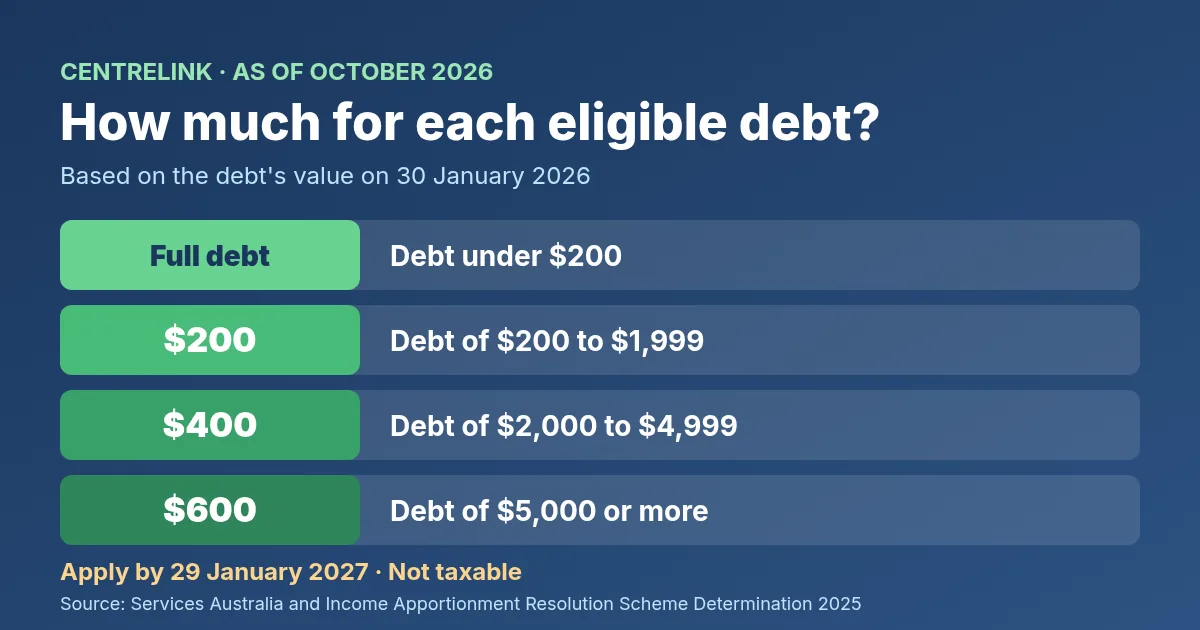
The payment depends on the total value of each debt as recorded by Services Australia on 30 January 2026. These bands are from Services Australia and the scheme’s rules, as of October 2026.
| Total debt value on 30 January 2026 | Payment for that debt |
|---|---|
| Less than $200 | The full debt amount |
| $200 to $1,999 | $200 |
| $2,000 to $4,999 | $400 |
| $5,000 or more | $600 |
- Repayments don’t count against you. Money you already paid back doesn’t lower the debt value.
- Waived amounts are taken out. Any part of the debt waived before 30 January 2026 isn’t counted.
- Interest charges aren’t counted, but the rules say any added penalty amount is part of the debt value.
- Each debt is paid separately. If you have more than one eligible debt, you can apply for each one.
Example from DSS (as of October 2026): a $5,000 debt had $2,000 waived in 2019. The person had also repaid $1,750.
The debt value is $5,000 minus the $2,000 waived, which is $3,000. The repayments don’t count, so the payment is $400 (as of October 2026).
Who is eligible for the Resolution Scheme?
Services Australia says you may be eligible if all of these apply:
- you got an employment income debt for a debt period between 20 September 2003 and 6 December 2020;
- the debt was likely affected by income apportionment;
- the debt was raised before 5 December 2025;
- you haven’t been prosecuted and found guilty of fraud for that debt; and
- the debt wasn’t waived in full or reduced to zero before 30 January 2026.
A partner’s pay can count. The DSS guide says the debt can come from your income or your partner’s income being apportioned.
One day is enough. DSS says if at least one day of the debt period falls in the eligible period, the whole debt can be eligible.
Which debts are left out?
- Fraud: debts linked to fraud found in criminal proceedings.
- Some older pension debts and Parenting Payment (partnered) debts, where DSS says apportionment was allowed by the law at the time.
- Debts already cancelled: debts waived in full before 30 January 2026, or found on a review before the scheme started not to exist or to be zero.
- Debts found to have another cause: debts a review before the scheme started found arose wholly for a reason other than income apportionment. This doesn't apply to debts about your or your partner's employment income that were reviewed between 1 October 2020 and 29 January 2026.
How do I apply?
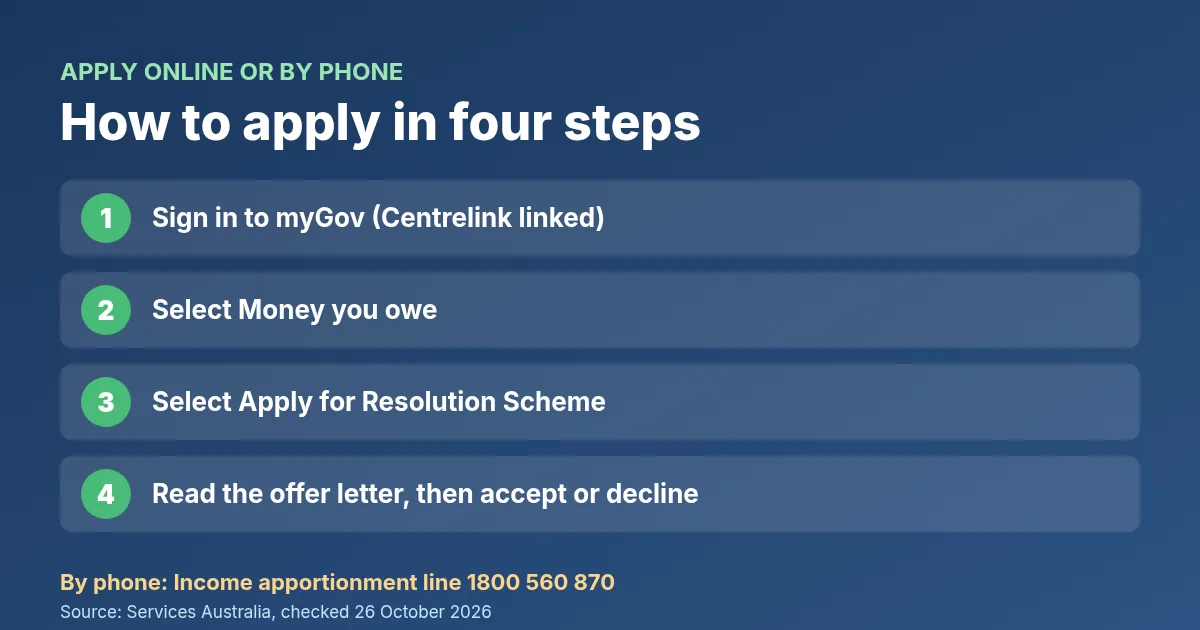
Online through myGov
- Sign in to myGov. Your Centrelink online account must be linked.
- Select Money you owe.
- Select Apply for Resolution Scheme. Any eligible debts will show here.
- Submit. Services Australia gives you a receipt ID and sends a confirmation letter.
No myGov or Centrelink online account? You need to create them first. Our myGov setup guide explains how.
By phone
- Income apportionment line: 1800 560 870, Monday to Friday, 8am to 5pm.
- Call this line if you only want to apply for some of your eligible debts, or a debt you think is eligible isn’t listed.
- Interpreter: ask and Services Australia will arrange one for free.
When is the deadline?
Applications opened on 30 January 2026 and close on 29 January 2027 (as of October 2026).
The scheme’s rules let Services Australia accept a late application before 30 January 2028, but only if special circumstances stopped you applying on time. Don’t rely on this.
What happens after I apply?
- Letter: Services Australia checks each debt and writes to you with the outcome. It can’t give an exact date.
- Offer: if a debt is eligible, the letter offers a payment. You can accept or decline it.
- Time to decide: under the rules, an offer is open for 56 days from its date (as of October 2026). You can ask for more time if special circumstances apply.
- How it is paid: into your bank account, or you can choose to use it to reduce another Commonwealth debt you owe.
- Review: the rules let you ask for a review of the amount within 56 days of the offer (as of October 2026).
If you are in financial hardship, Services Australia says to call your regular payment line.
How does accepting affect my legal rights?
If you accept a payment for a debt, Services Australia says you agree to all of these:
- release the Commonwealth from all liability for claims about using income apportionment on your debt;
- not bring, or continue, legal action about it for that debt; and
- not seek other compensation for that debt.
Your review rights stay. Applying doesn’t stop you seeking a review of the decision to raise or recover the debt.
Robodebt class action: if you are a registered group member of the robodebt class action appeal, Services Australia says your settlement payment won’t be affected.
Services Australia recommends independent legal advice if you are worried about accepting an offer.
Is the Resolution Scheme payment taxable?
No. Services Australia says Resolution Scheme payments aren’t taxable and won’t be assessed as income. You don’t need to report the payment to Services Australia.
The DSS guide says a resolution payment is not subject to tax under any Commonwealth law. A 2026 Determination also makes it an exempt lump sum, so it isn’t counted as income for your Centrelink payments.
Common questions about the income apportionment payment
How much is the Centrelink income apportionment payment?
As of October 2026, it is up to $600 for each eligible debt. A debt under $200 gets the full debt amount, $200 to $1,999 gets $200, $2,000 to $4,999 gets $400, and $5,000 or more gets $600.
The amount is based on the debt’s value on 30 January 2026.
When do applications close?
Applications close on 29 January 2027 (as of October 2026). They opened on 30 January 2026.
The rules allow a late application before 30 January 2028 only if special circumstances stopped you applying in time.
How do I apply for the Resolution Scheme?
If your Centrelink online account is linked to myGov, sign in, select Money you owe, then select Apply for Resolution Scheme. You can also apply by phone on the Income apportionment line, 1800 560 870.
Is the Resolution Scheme payment taxable?
No. Services Australia says Resolution Scheme payments aren’t taxable and won’t be assessed as income. You don’t need to report the payment to Services Australia.
Does it matter if I already paid back my debt?
No. Services Australia says money you have already repaid won’t affect the amount of your payment. Any part of the debt waived before 30 January 2026 is not counted.
Can I get a payment for more than one debt?
Yes. If you have more than one eligible debt, you can apply for a payment for each one.
Will accepting the payment affect my rights?
Yes. If you accept, you release the Commonwealth from claims about the use of income apportionment on that debt and agree not to take legal action or seek other compensation for it.
Applying doesn’t stop you asking for a review of the debt itself. Services Australia suggests independent legal advice if you are worried.
Official sources checked on 26 October 2026
- Services Australia: Income Apportionment Resolution Scheme
- Services Australia: Information about income apportionment (includes the Income apportionment line)
- DSS Social Security Guide 4.5.3.30: Application for resolution payment
- DSS Social Security Guide 4.5.3: Income Apportionment Resolution Scheme
- DSS Social Security Guide 4.5.3.10: Eligibility
- DSS Social Security Guide 4.5.3.20: Resolution payment amounts
- DSS Social Security Guide 4.5.3.50: Acceptance and processing of a resolution payment
- DSS: Public statement on income apportionment
- Federal Register of Legislation: Income Apportionment Resolution Scheme Determination 2025 (compilation of 27 June 2026)
- Federal Register of Legislation: Social Security (Exempt Lump Sum – Income Apportionment Resolution Scheme Payments) Determination 2026
General information only: This guide is not legal, financial or tax advice and is not from Services Australia. Rules and dates can change. Check the linked official pages and your own myGov account before you act.